
There are two ways to sell to Canadian customers from outside Canada. Either your customer is the importer, and pays the duty, tax and a courier fee at the door, or your business is the importer, pays at the border and builds the cost into your Canadian price. Most direct-to-consumer brands start with the first because it needs no setup. The second is where the refused parcels stop, and it comes with a Canadian business number, the CBSA’s CARM system and a GST/HST decision that determines whether the 5% border GST is a cost you absorb or a credit you claim back.
Who pays the duty and tax when a Canadian buys from your site
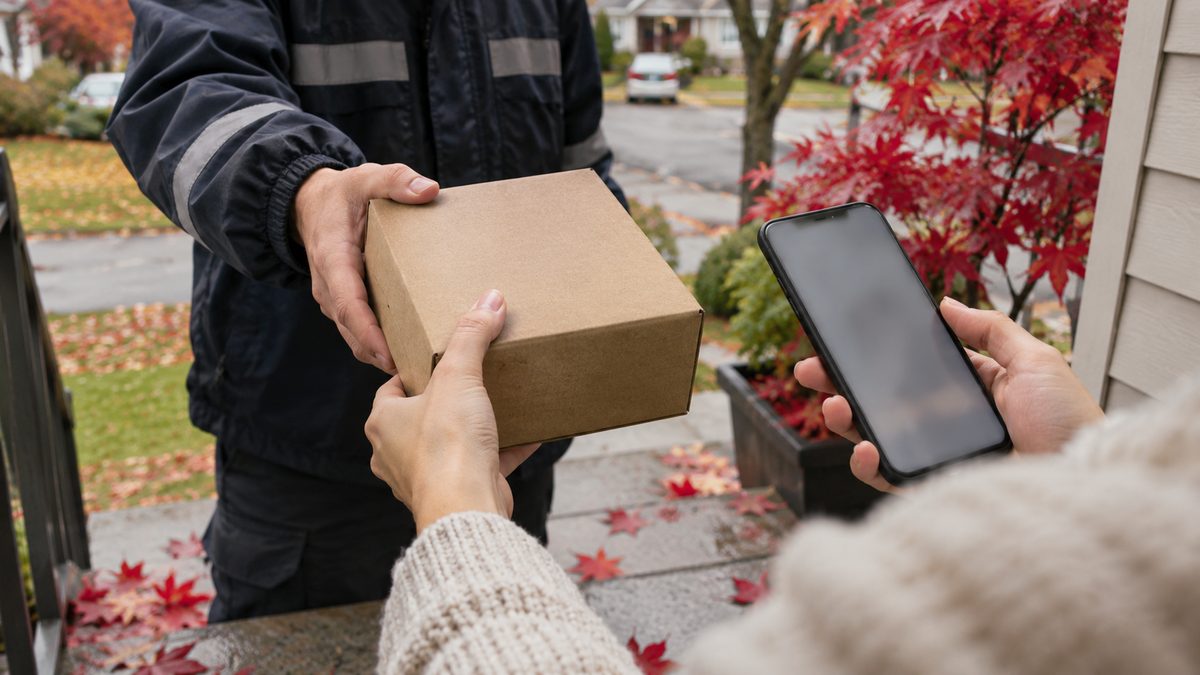
By default, the person receiving the parcel is the importer. The Canada Border Services Agency (CBSA) assesses what’s owed and the courier or Canada Post collects it before handing over the box. If you aren’t registered for GST/HST, you don’t charge Canadian tax at checkout in this setup. The CBSA picks the tax up on import instead.
What your customer pays depends on how the parcel travels and what it’s worth in Canadian dollars.
| How it arrives | No tax up to | No duty up to | Collection fee |
|---|---|---|---|
| Mail, from any country | $20 | $20 | Canada Post, $9.95 per item |
| Courier from the US or Mexico | $40 | $150 | The courier’s brokerage fee |
| Courier from anywhere else | $20 | $20 | The courier’s brokerage fee |
Past those lines, the tax on a consumer’s parcel is the GST plus the provincial part for the destination province: the full HST for a buyer in Ontario or the Atlantic provinces, and the PST or QST for British Columbia, Manitoba, Saskatchewan and Quebec, which the CBSA collects under agreements with those provinces. Alberta and the territories have no provincial sales tax, so those buyers pay the 5% GST only. Duty depends on the tariff classification and on where the goods were made. A hoodie sewn in Vietnam and shipped from your Ohio warehouse isn’t a US-origin good, so the CUSMA duty treatment doesn’t rescue it above $150. Separately, since September 8, 2026 Canada applies counter-tariffs to a list of US-origin goods, so a product that does qualify under CUSMA can still owe a surtax. Check your tariff classifications against the current list before you set landed prices.
So a $100 order delivered by courier to a customer in Toronto shows up with $13 of HST on the goods alone, plus the courier’s brokerage fee, before any duty. Canadians know this, and plenty of them abandon the cart over it. That’s why the second route exists.
Taking over the import: becoming the non-resident importer of record

Delivered duty paid (DDP) flips the arrangement. You quote a landed price, collect the duty and tax at checkout, and your business is named as the importer of record when the shipment clears. The customer gets the box with nothing to pay. The CBSA calls a foreign business in that position a non-resident importer, and it’s treated much like a Canadian importer, with a few extra steps.
- A nine-digit business number from the Canada Revenue Agency. Non-residents can’t get it through the CARM portal. The CRA issues it first, then the import-export (RM) account is added in the CARM Client Portal.
- A CARM Client Portal account managed by someone at your own company, with your customs broker approved as a delegate. Since May 20, 2025 a broker’s security no longer covers its clients, so if you want goods released before you pay, you post your own financial security in the portal. The CBSA sets it at no less than 50% of your highest monthly amount owing over the past year, with a $5,000 minimum, or a cash deposit for the full amount.
- Your own importer account on every shipment. Until December 31, 2025 a broker could clear commercial goods on its own business number for a non-resident that hadn’t finished registering. That transition measure has ended (Customs Notice 24-27), which is why couriers are now asking DDP shippers to register.
- A place to keep your import records that the CBSA accepts. More on that below.
Once you’re the importer, your parcels are commercial goods, and the CBSA taxes them differently from a consumer’s parcel. Duty is assessed on the same tariff basis, but only the 5% GST is collected at the border. The provincial part of the HST isn’t payable on commercial imports. It’s handled on the sale, and that’s where the next section comes in.
The GST/HST decision that makes or breaks the DDP math

Above the courier exemption limits, every DDP order you import carries 5% GST at the border. What happens to that 5% depends entirely on whether your business is registered for GST/HST.
If you’re not registered, the border GST is a cost you eat. The CRA’s guide for non-residents is blunt about the rest: a non-registrant that imports goods and sells them doesn’t charge GST/HST to its customers, even when the goods are delivered in Canada. So you can’t bill the tax to the buyer and you can’t claim it back. On a $100 order that’s $5 gone, every order.
If you’re registered, the tax passes through you instead of landing on you. You charge GST/HST on the sale at the rate for the customer’s province (5% in Alberta, 13% in Ontario, 14% in Nova Scotia, 15% in the other Atlantic provinces, with PST or QST a separate question in the four provinces that have it) and you claim the 5% you paid at the border as an input tax credit, along with the GST on your Canadian freight, returns handling, advertising and any 3PL fees. The import accounting has to show your business number as the importer for that credit to hold up, which is one more reason to get the CARM side right before you start.
The trade-off is at checkout. A registered seller charges the full HST to customers in Ontario and the Atlantic provinces, 13% to 15%, where an unregistered DDP seller charges nothing and absorbs the 5%. Which works better depends on your prices and margins. In our experience the brands that register price the tax in at checkout, the way every Canadian retailer does, and keep the credit.
The rule on when you have to register, in the words we use with every non-resident client: you must register once your total taxable sales over four consecutive quarters, added together, pass $30,000. You can register voluntarily before that, and most sellers do from day one to claim back the GST they pay. Registering from day one is the usual choice for a DDP brand, because the border GST starts on your first shipment and doesn’t wait for a threshold.
One trap to plan for. If Canadian volume grows and you move stock into a Canadian fulfillment warehouse to ship domestically, the rules change again. Since July 1, 2021 a non-resident selling goods from Canadian-held inventory to Canadian consumers has to register once those sales pass $30,000 in a 12-month period, under the normal GST/HST rules. Where your inventory sits is also one of the factors the CRA weighs in deciding whether you’re carrying on business in Canada. The 3PL contract answers neither question, so get your position assessed before the pallets move. Our guide to GST registration for non-residents covers what registration involves, and our GST/HST service handles it.
CARM’s quiet requirement: where your import records live

The part of becoming an importer that catches DTC brands off guard has nothing to do with duty rates. As the importer of record you keep the records of each importation for six years following the importation of the goods, and CBSA Memorandum D17-1-21 is specific about where. The default is a place of business in Canada. Under the CBSA’s current policy the only alternatives are the United States or Mexico, with the CBSA’s approval, or an agent in Canada who holds the records for you under an agreement called the BSF900.
The records go well beyond the customs entries. The list covers the origin, marking, purchase, importation, costs and value of the goods, payment for them, and their sale or other disposal in Canada. For a DTC brand that means supplier invoices and proof of payment, the commercial invoices and accounting declarations for each shipment, and your Canadian order and payout data. The CARM portal itself isn’t a record-keeping location.
A US brand that keeps its books at its US office can ask the CBSA to approve that location. A brand whose bookkeeper, servers or head office sit anywhere else needs an approved records location in Canada, the US or Mexico, which for most means a Canadian records agent. When you enrol in the Importer program the portal asks whether your books and records are kept in Canada before it issues the RM account, and since May 13, 2024 an importer that needs a BSF900 doesn’t get its import-export account until the agreement is approved. Settle this at the start of the project. Waiting until the first shipment is stuck adds weeks.
That’s the service we built for non-resident importers. We prepare the BSF900 and the engagement letter, you sign them and upload them in your own CARM Client Portal account, and we hold your import records on Canadian servers for the six years. Your courier and broker can change any time without touching the arrangement.
Frequently asked questions
Do I have to charge Canadian sales tax if my customer pays the duty and tax at the door?
No, as long as you aren’t registered for GST/HST. The CBSA assesses the GST, the provincial part where it applies and any duty when the parcel enters, and the courier or Canada Post collects it on delivery. If you are registered, check how your shipping terms are written before you rely on that, because they decide where the sale takes place.
Are goods shipped from the United States duty-free under CUSMA?
Only if the goods themselves qualify as originating under the CUSMA rules of origin, which depends on where and how they were made, not on where your warehouse is. Goods made in Asia and shipped from a US fulfillment centre are assessed duty on their own origin. Separately, any courier shipment from the US or Mexico worth $150 or less is duty-free, and $40 or less is tax-free as well, whatever the origin of the goods, as long as they ship from stock held in the US or Mexico. Parcels that only pass through get the $20 limit. Since September 8, 2026, some US-origin goods also carry a Canadian counter-tariff, so check the current list for your products.
Do I need a Canadian company or a Canadian address to be the importer of record?
No. A business located outside Canada can import as a non-resident importer. It needs a business number from the CRA, an import-export account in the CARM Client Portal, its own financial security for release prior to payment, and a CBSA-approved location for its books and records. If that records location is in Canada it has to be a real place of business or an approved agent. The CBSA doesn’t accept post office boxes or mail-forwarding addresses.
What’s the difference between the tax on my customer’s import and the tax on my DDP import?
A consumer’s parcel is a casual import, so the CBSA collects the GST plus the provincial part (the HST, or the PST or QST in British Columbia, Manitoba, Saskatchewan and Quebec) along with any duty. Your DDP parcel is a commercial import, so the CBSA collects duty and the 5% GST only. If you’re registered for GST/HST you charge the full GST or HST on the sale and claim the border GST back as an input tax credit.
Can my courier handle CARM and the records for me?
Partly. FedEx, UPS and the other couriers act as customs brokers, so you can delegate them in your CARM portal to file your import accounting. The financial security is yours to post, and the record-keeping obligation stays with you as the importer. Neither FedEx’s nor UPS’s CARM pages offer to hold your books and records, so if you want your courier to do it, ask in writing. Our guide to what the FedEx and UPS CARM emails leave out goes through it.
Related guides
- Non-resident importer to Canada: the complete setup guide
- GST registration for non-residents
- CBSA CARM Client Portal for importers: 2026 setup guide
- FedEx or UPS told you to register for CARM? What a non-resident importer actually has to do
- CBSA books and records custodian service for non-resident importers
Selling to Canadians and not sure who the importer should be?
Tell us how you ship today and where your books are kept, and we’ll tell you whether DDP makes sense, what GST/HST registration would recover, and whether you need a Canadian records agent. Our CBSA books and records service is one plan at $999 USD a year, setup included, and we prepare the BSF900 and engagement letter for you to upload in your own CARM portal. Start with a short note about your business.
Related guides
Get the tax side right the first time.
We work with e-commerce and owner-managed businesses across Canada and beyond: GST/HST and provincial sales tax, corporate structure, income splitting, and non-resident compliance. Tell us your situation and we will tell you exactly what you need.
Get in touch