Exit planning is the process of preparing your business, your finances, and yourself for the day you stop being the owner. It’s not a single event. It’s a 1-3 year project that touches your tax structure, your operations, your personal wealth plan, and ultimately, the sale price someone puts on your life’s work.
Most business owners don’t plan their exit. They react to it. A health scare, a burnout, a surprise offer. And because they weren’t ready, they leave hundreds of thousands of dollars on the table. This guide is designed to change that.
Why Don’t More Canadian Business Owners Have an Exit Plan?
Because nobody forces them to create one. And because running the business takes all their energy.
Here’s the data: 58% of business owners have no exit plan at all (Project Equity). That number hasn’t moved much in the last decade. And 80% of business owners say they plan to exit within 10 years, yet only 30% have a formal plan (Business Enterprise Institute). The gap between intention and action is enormous.
The result? 92% of small business exits happen through closure, not sale. The owner just stops. Locks the door. Walks away from whatever equity they’d built because they never converted it into something a buyer could evaluate.
That’s not a business exit. That’s a business burial.
If you’re a Canadian business owner doing $500K or more in annual revenue, you’ve built something with real value. But value only matters if you can prove it, transfer it, and capture it in a transaction. That’s what exit planning does.
What Is Exit Planning, Really? (And What It Isn’t)
Exit planning is not selling your business. That’s a common mistake. Selling is the last step. Exit planning is everything that comes before: 12 to 36 months of preparation that makes the sale possible, profitable, and structured in a way that minimizes your tax bill.
It includes:
- Getting your financials into shape a buyer will trust
- Reducing your personal involvement so the business runs without you
- Documenting processes, contracts, and customer relationships
- Structuring the deal to qualify for tax exemptions (like the LCGE)
- Aligning your personal financial plan with the proceeds
What it’s NOT: a valuation report you stick in a drawer. A lot of business owners think they’ve “done” exit planning because they got an appraisal three years ago. That’s one input. The plan is the whole system around it.
The Tax Paradox: Why Your CPA Has Been Working Against Your Sale Price
Here’s something that surprises every business owner we work with.
For years, your accountant has been doing their job: minimizing your taxable income. Writing off your truck. Running personal expenses through the business. Maximizing deductions. Depreciating assets aggressively. That’s smart tax strategy, and it saved you real money every April.
But it created a problem you didn’t know about.
When a buyer looks at your financial statements, they see a business that barely makes money. Your net income is artificially low because your CPA designed it that way. The buyer sees $150K in profit when the business actually generates $400K in economic earnings.
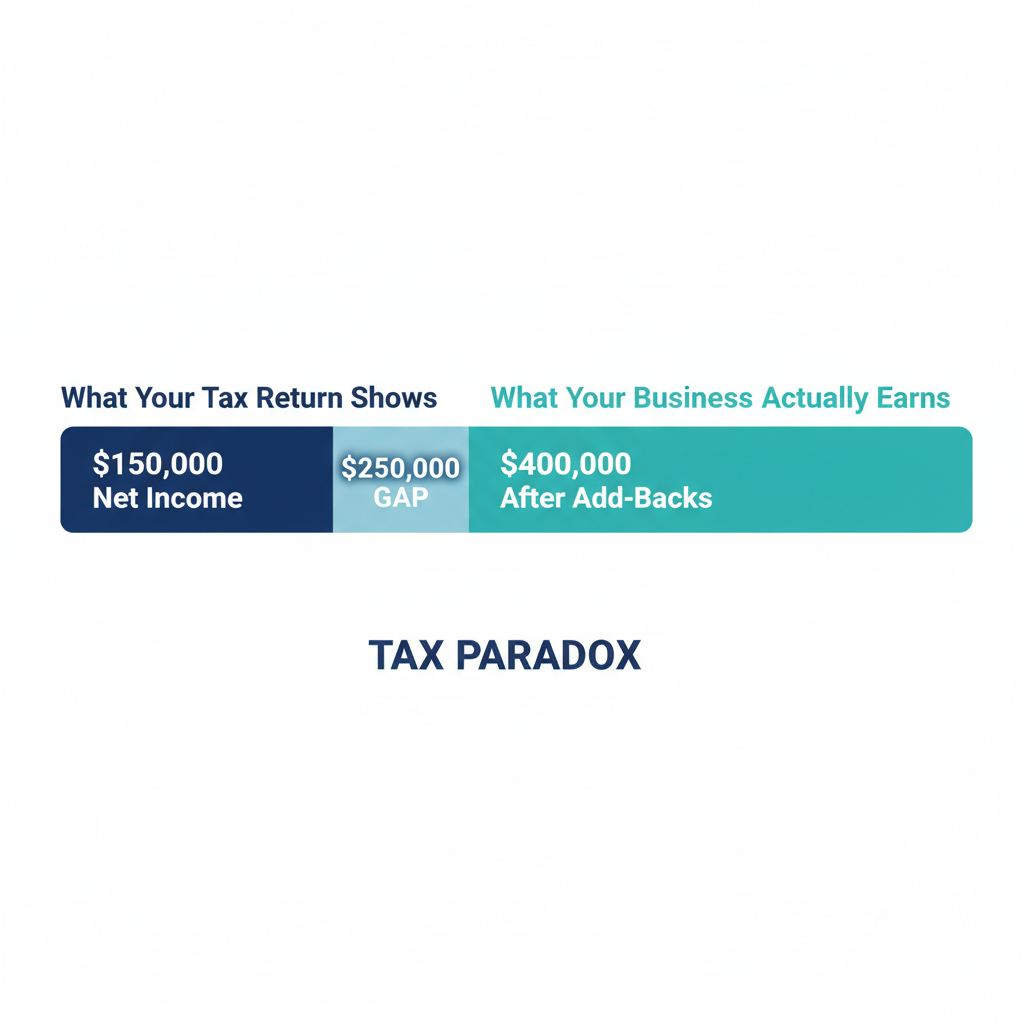
This is what we call the Tax Paradox of exit planning. The very strategies that saved you taxes now cost you on your sale price.
Fixing this requires a process called financial normalization. You go through every line item and identify “owner add-backs”: expenses that a new owner wouldn’t incur. Your spouse’s salary for a role that doesn’t need filling. The family truck. The “business trip” to Costa Rica. Below-market rent on a property you own personally. Personal insurance running through the company.
Here’s what that looks like in practice:
| Line Item | On Your Tax Return | After Normalization |
|---|---|---|
| Net Income (as filed) | $150,000 | $150,000 |
| Owner’s salary above market rate | included in expenses | + $80,000 |
| Spouse on payroll (no-show role) | included in expenses | + $45,000 |
| Personal vehicle | included in expenses | + $18,000 |
| Personal travel | included in expenses | + $12,000 |
| Personal insurance | included in expenses | + $9,000 |
| One-time legal fees | included in expenses | + $15,000 |
| Below-market rent adjustment | — | + $24,000 |
| Adjusted SDE | $150,000 | $353,000 |
| At 3x multiple | $450,000 sale price | $1,059,000 sale price |
Same business. Same revenue. Same customers. The difference? $609,000 in sale price, just from presenting the financials properly.
And that’s a conservative example. Cleaning up financials can move a business from 2-3x SDE to 4-6x EBITDA (International Business Brokers Association). On a $500K SDE business, that’s the difference between a $1.5M sale and a $3M+ sale.
We literally undo years of tax strategy to prove your business is worth more. And then we help you restructure the sale to get the tax savings back on the other side.
What Are the Four Main Ways to Exit a Business in Canada?
Not every exit is a sale. There are four routes, and each one has different tax implications, timelines, and emotional weight.
| Exit Route | Typical Timeline | LCGE Eligible? | Best For |
|---|---|---|---|
| Sell to third party | 12-24 months total | Yes (share sale) | Highest price, clean break |
| Transfer to family | 1-3 years (gradual) | Yes (with planning) | Keeping it in the family |
| Management buyout / ESOP | 1-3 years (often seller-financed) | Yes (share sale) | Strong management team, no family successor |
| Wind down | 3-6 months | No | Owner-dependent businesses, small operations |
Sell to a Third Party.
This is what most people picture. A buyer, often from outside your industry or a competitor, purchases the business. It produces the highest sale prices, but requires the most preparation.
Transfer to Family.
Only 30% of family businesses survive to the second generation, and just 12% make it to the third (Family Enterprise Foundation). The failure rate isn’t because the kids aren’t capable. It’s because the transition was never planned. Family transfers need formal governance, a buy-sell agreement, clear timelines, and honest conversations about who actually wants to run the business.
Sell to Employees (Management Buyout or ESOP).
Your management team already knows the business. They’re motivated. And employee ownership transitions can be structured over time, which spreads your tax exposure. The downside: employees often can’t pay full market price. Seller financing is common, which means you carry risk.
Wind Down.
Sometimes the right answer is to shut it down, liquidate assets, and move on. This isn’t a failure. If the business value is primarily in you, a wind-down might net you more than a sale that requires months of preparation and earnout clauses you’ll resent.
The CRA treats each of these differently. Share sales may qualify for the Lifetime Capital Gains Exemption (LCGE), which in 2026 shelters up to $1,275,000 per individual from capital gains tax (indexed to inflation). Asset sales don’t qualify. The structure of your exit directly determines your after-tax proceeds.
What Do Buyers Actually Look For?
Forget what you think your business is worth. Here’s what a buyer’s due diligence team will examine in the first 48 hours:
Financial clarity. Three to five years of clean financial statements with consistent revenue trends. If your bookkeeping is a mess, the buyer discounts the price or walks.
Recurring revenue. A business with $600K in annual subscriptions is worth significantly more than one with $600K in project-based revenue. Predictability is worth a premium.
Owner independence. If the business falls apart without you, it’s not a business. It’s a job. Buyers pay more when there’s a management team that can run operations after you leave.
Customer concentration. If one customer represents 30%+ of revenue, buyers will flag it. For e-commerce sellers, this is less about individual customers and more about channel mix. And look, if you’re doing most of your revenue on Amazon, that’s not unusual. That’s modern e-commerce. But a buyer will want to see that you’ve at least thought about diversification, even if Amazon is still your primary channel. Having a Shopify store or a DTC presence, even a small one, signals that the business isn’t locked into a single platform.
Documented processes. Standard operating procedures, training manuals, vendor agreements, employee contracts. A buyer needs to see that the knowledge isn’t all in your head.
Growth story. Buyers aren’t just buying today’s cash flow. They want to believe they can grow it. Having data-backed growth opportunities documented adds real value.
Here’s the honest truth: most businesses aren’t sale-ready when the owner first decides to sell. That’s normal. The preparation period exists for exactly this reason.
How Long Does This Actually Take?
Longer than you think. Here’s the typical timeline:
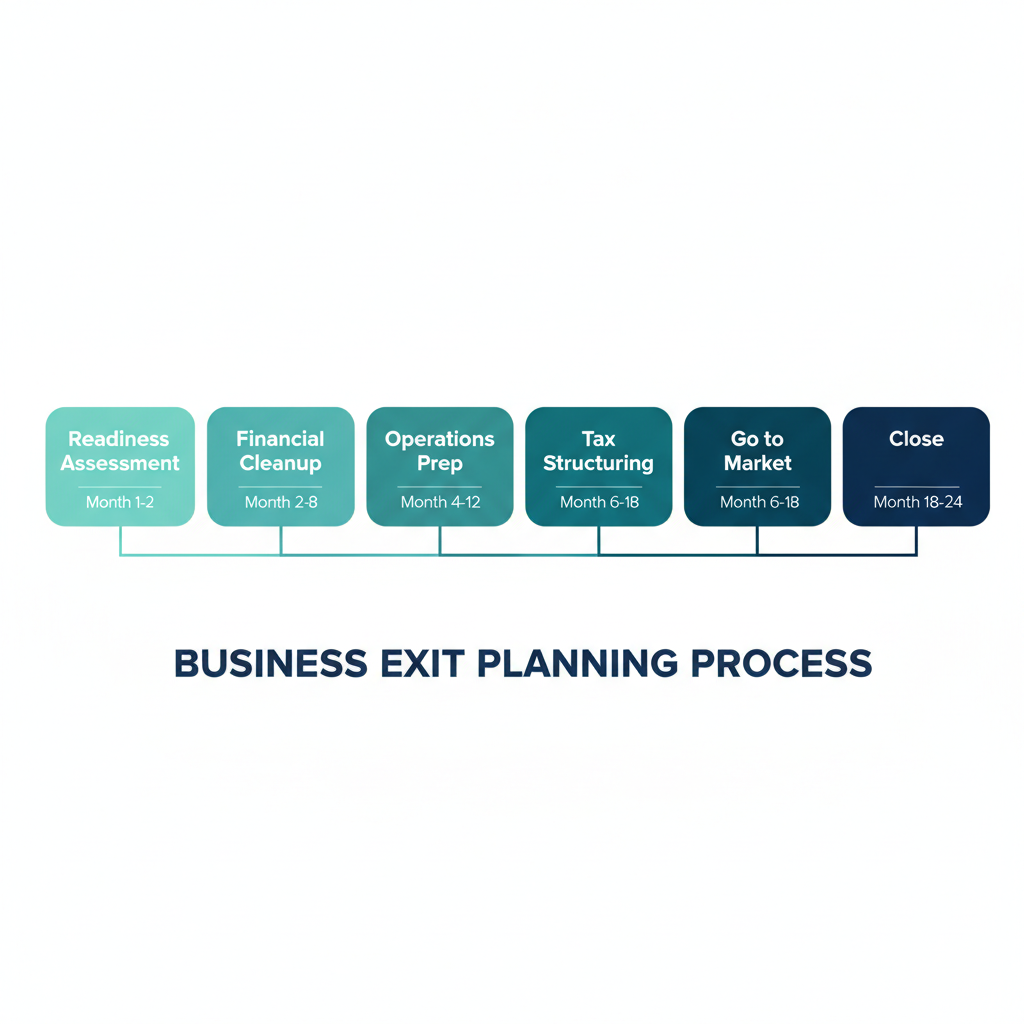
| Phase | Timeframe | What Happens |
|---|---|---|
| Readiness assessment | Month 1-2 | Financial analysis, gap identification, SDE/EBITDA calculation |
| Financial cleanup | Month 2-8 | Normalize earnings, document add-backs, restructure if needed |
| Operations prep | Month 4-12 | Reduce owner dependence, document processes, strengthen team |
| Tax structuring | Month 6-18 | LCGE qualification, holding company setup, estate freeze if applicable |
| Go to market | Month 12-18 | Engage broker, create CIM, field buyer interest |
| Due diligence and close | Month 18-24 | LOI, negotiation, QoE, legal, closing |
Preparation phase: 6-18 months. This is where you clean up financials, document your add-backs, reduce owner dependence where you can, and get your tax structure right. Some of this, like corporate restructuring for LCGE qualification, has mandatory waiting periods under CRA rules. The sooner you start, the more options you have.
Marketing and due diligence: 6-12 months. Once the business is sale-ready, a broker or M&A advisor takes it to market. Buyer interest, NDAs, LOIs, due diligence, negotiation, and closing all happen in this window.
Total from decision to deposit: 12-24 months for most e-commerce businesses. Can it happen faster? Yes. If your books are already clean and a motivated buyer shows up, three to six months is possible. We’ve seen it happen.
The owners who get the best deals are the ones who had their financials organized before they needed to sell. That gives you the option of waiting for the right offer instead of taking the first one.
What Role Does Your CPA Play in Exit Planning?
Your CPA should be the quarterback of your exit planning team. Not the only player, but the one who coordinates everyone else: the business broker, the lawyer, the financial planner, the wealth advisor.
Why the CPA? Because your accountant already knows the numbers better than anyone. They’ve seen the real financial picture. They know which expenses are legitimate and which ones are personal. They know the tax exposure and the LCGE eligibility requirements.
At Jones & Cosman, we handle the financial side of exit planning in three tiers:
| Service | Price | Timeline | What You Get |
|---|---|---|---|
| Exit Readiness Check-Up | $3,500-$5,000 | 2-3 weeks | Financial analysis, preliminary SDE/EBITDA, written gap report |
| Sale-Ready Financials | $7,500-$15,000 | 6 months | Full recast of 3-5 years of statements, documented add-backs, buyer-ready financials |
| Full Exit Planning | $15,000-$25,000 | 12 months | Everything above plus tax structure optimization, CIM support, and deal coordination |
We also have a free Exit Readiness Scorecard on our website. It takes about 10 minutes and gives you a score across four areas: finances, operations, planning, and profitability. It won’t replace a professional assessment, but it’ll tell you how much work you have ahead of you.
When Should I Actually Start Exit Planning?
The textbook answer is 3-5 years. The honest answer? Most e-commerce sellers don’t think about this until they’re 12-18 months out, and that’s okay. You can do a lot in a year if you’re focused.
Here’s what matters: start before you need to. Even a quick readiness check-up 12-18 months out gives you enough time to clean up financials, document your add-backs, and make sure your corporate structure doesn’t cost you $200K+ in avoidable tax. We’ve seen that exact scenario play out. One client spent $4,000 on a readiness assessment and discovered a corporate restructuring that saved over $200,000 in capital gains tax. But that restructuring took 24 months under CRA rules. If they’d waited, that window would have been closed.
Nobody’s going to spend five years prepping an exit. But spending a few months cleaning up your books and understanding your options? That’s realistic. And it’s the difference between reacting to an offer and negotiating from a position of strength.
Also plan for the exits you don’t choose. The “Four Ds”: death, disability, disease, and divorce. Each one can force a sale. Having your financials organized and a rough plan in place means your family isn’t scrambling.
What E-Commerce Sellers Should Know
We work with Amazon sellers, Shopify store owners, and e-commerce operators all over the world. There are a few things specific to this space that matter when you’re thinking about an exit.
Channel concentration is normal. Let’s be real: if you’re an Amazon seller, most of your revenue comes from Amazon. That’s not a flaw in your business. That’s how e-commerce works right now. Buyers know this. What they care about is whether you’ve built a brand that could survive outside of one channel. A Shopify presence, even a small one, or a growing DTC email list shows the business has legs beyond a single marketplace. You don’t need to be 50/50 across channels. Just show that you’ve started.
Account health matters. Suspensions, policy violations, or IP complaints in your Amazon account history reduce value. Clean these up well before you go to market.
Inventory valuation. How you value inventory matters more than you think. FIFO vs. weighted average cost, write-downs on slow-moving SKUs, and landed cost accuracy all affect what a buyer sees on your balance sheet.
SDE vs. EBITDA. Most Amazon businesses under $5M in revenue sell on an SDE basis (2-4x). Larger operations sell on EBITDA (4-8x). Knowing which metric applies to you and optimizing for it makes a real difference in your sale price.
The buyer market. Amazon aggregators raised billions between 2020 and 2024. That wave has cooled, but experienced buyers are still acquiring strong e-commerce brands. They’re pickier now, which means your financials need to be clean. The days of getting 5-6x on messy books are gone.
Frequently Asked Questions
How much does exit planning cost in Canada?
An initial readiness assessment typically runs $3,500-$7,500. A full exit planning engagement ranges from $15,000-$50,000+ depending on complexity. At Jones & Cosman, our three tiers range from $3,500 for a check-up to $25,000 for full exit planning. The ROI is usually 10-50x the investment in increased sale price and tax savings.
Can I sell my business without a broker?
You can, but you probably shouldn’t. Brokers typically charge 8-12% commission, which feels expensive until you realize that businesses sold through brokers close at higher prices and faster than owner-led sales. The exception: if you already have a buyer (like a competitor or employee), you may only need legal and accounting support.
What is the Lifetime Capital Gains Exemption (LCGE) for 2026?
The LCGE for 2026 is $1,275,000 per individual, indexed to inflation. It applies to the sale of qualified small business corporation (QSBC) shares. To qualify, the corporation must be a Canadian-controlled private corporation (CCPC), you must have held the shares for at least 24 months, and at least 50% of assets must be used in an active business. With proper planning, both spouses can claim it, potentially sheltering $2,550,000 in combined capital gains.
How is a business sale taxed in Canada?
It depends on whether you structure the deal as an asset sale or a share sale. Share sales may qualify for the LCGE and are taxed at the capital gains inclusion rate, which remains at 50% for 2026. Asset sales are split into components (goodwill, equipment, inventory) and each is taxed differently. The structure significantly affects your after-tax proceeds, which is why you need a CPA involved early.
What is the difference between SDE and EBITDA?
SDE (Seller’s Discretionary Earnings) includes the owner’s salary and benefits added back to net income. It represents what one owner-operator would earn. EBITDA does not add back owner compensation, assuming the buyer will hire a manager. SDE is used for smaller businesses (under $5M revenue), EBITDA for larger ones. The distinction matters because they produce different multiples.
Do I need to tell my employees I’m selling?
Not immediately, and not all of them. Premature disclosure can cause key employees to leave, which destroys value. Most advisors recommend telling your management team 6-12 months before close, after an LOI is signed. Rank-and-file employees typically learn at closing. If you’re selling to employees, obviously, the conversation happens earlier.
How do I find out what my business is worth?
Start with a rough calculation: take your SDE or EBITDA and multiply by the typical range for your industry (2-4x SDE for small businesses, 4-8x EBITDA for mid-market). For a formal number, hire a Chartered Business Valuator (CBV) in Canada, which typically costs $5,000-$20,000 depending on complexity. Or start with our Exit Readiness Check-Up, which includes a preliminary valuation calculation.
Rob Cosman is a CPA at Jones & Cosman CPA, where the firm works with e-commerce sellers and online business owners worldwide on accounting, tax, and exit planning. Take the free Exit Readiness Scorecard to see where your business stands.
Related Articles
- How to Close Your Corporation in Canada: Step-by-Step Checklist
- Should You Incorporate as A Canadian Amazon Seller?
- Health Spending Accounts (PHSP) for Canadian Small Business Owners: The Complete Guide
Related guides
Get the tax side right the first time.
We work with e-commerce and owner-managed businesses across Canada and beyond: GST/HST and provincial sales tax, corporate structure, income splitting, and non-resident compliance. Tell us your situation and we will tell you exactly what you need.
Get in touch